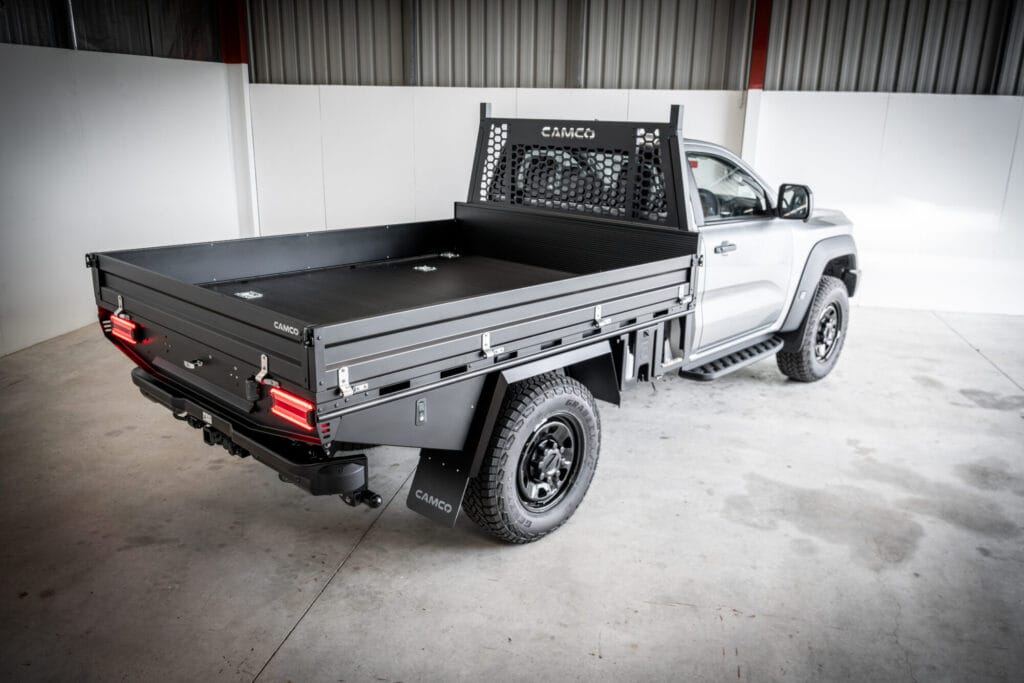

Payload and weight distribution
Payload remains one of the most consistently misunderstood aspects of light commercial vehicle specification. While GVM figures are widely referenced, they are often treated in isolation, without sufficient consideration of axle ratings, GCM limits, or payload distribution.
Historically, payload and axle assessments across the industry have relied on estimated calculations or static assumptions. In recent years, we have adopted a payload analysis tool that allows us to model real-world operating conditions with a high degree of accuracy.
Using this system, we can provide:
- Payload figures accurate to the nearest kilogram
- Payload positioning accurate to the millimetre
- Front and rear axle load analysis
- Centre of gravity and rollover threshold modelling
- Scenario-based comparisons across vehicle variants
This process forms a key part of fleet due diligence. By inputting actual operating data, we can identify compliance risks early and support evidence-based vehicle selection.
Recently, we assisted a customer requiring the towing of a large loader machine with multiple attachments. The operating envelope was tight: a fully laden 3,500 kg trailer combined with additional payload carried on the tow vehicle. Through comparative modelling across several vehicle platforms, we were able to demonstrate which option remained compliant across GVM, axle ratings, and GCM — and where others did not.
Two areas that continue to present risk across fleets are:
Gross Combined Mass (GCM)
GCM represents the total mass of the vehicle and trailer combination. It is a common misconception that GCM equals GVM plus maximum tow rating. In practice, manufacturers often specify a lower GCM to manage drivetrain loads and durability. Our modelling tools automatically account for manufacturer GCM limits and flag non-compliant combinations during scenario testing.
Axle load exceedance
Axle overload — particularly on rear axles of double-cab utes — is frequently observed even when vehicles remain within stated GVM. By accurately modelling payload location, we can identify axle overload risk early and recommend changes to fit-out configuration or alternative vehicle platforms where required.
Until next time — we look forward to sharing more practical insights that support safer, more compliant fleet outcomes.
Regards,
Carl Blackman